
When I first started looking into the whole bifold and sliding door comparison, I honestly thought it would be a five-minute decision. Pick the one that looks nicer, done. But the deeper I explored it, the more I realised that this is one of those home renovation choices that actually changes how you live in your space every single day.
If you’re comparing bifold vs sliding doors for your home, you’re probably in one of two groups. Either you’ve fallen in love with the look of bifold doors after seeing them on a home renovation show, or someone told you sliding doors were the “smarter” option, and now you are confused. Both groups are valid. And both types of doors can genuinely transform a space — they just do it differently.
Here’s the thing nobody really tells you upfront: the “better” door isn’t about which one wins on a spec sheet. It’s about which one actually suits how you live. A bifold door that opens your entire kitchen wall to the garden is incredible if you have the garden, the room size, and the lifestyle to use it. A sliding door with a wall of glass and barely any frame is stunning if clean lines and low maintenance matter more to you than a fully open connection.
That’s what this guide is about. Not just the differences, but helping you figure out which one is actually right for your home.
Bifold vs Sliding Doors: Quick Comparison
Let’s start with a straightforward overview before we get into the details:
| Feature | Bifold Doors | Sliding Doors |
| Opening style | Panels fold and stack to the side | Panels glide horizontally on a track |
| Space needed | Needs clearance for panels to fold into | Stays within the wall’s footprint |
| How much opens | Nearly the whole doorway | Around half (one panel usually stays fixed) |
| Best suited for | Indoor-outdoor living, full openings | Views, modern design, tighter spaces |
| Cost | Generally higher | Usually more affordable |
| Maintenance | More moving parts to keep on top of | Simpler, less to worry about |
| Natural light (closed) | More frames interrupt the glass | Larger unbroken panes let more light in |
Now let’s actually talk through what all of this means in real life.
What Are Bifold Doors?
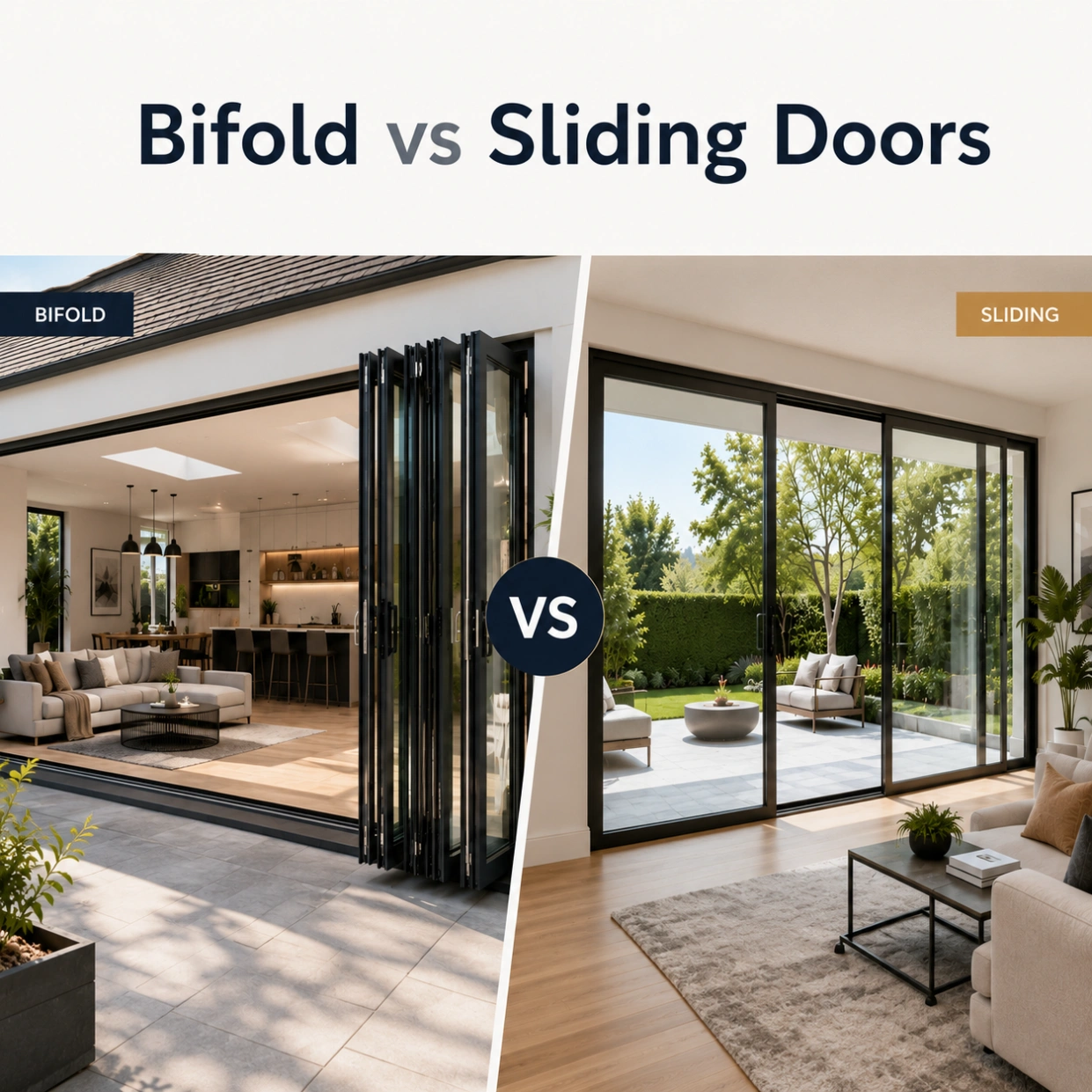
Bifold doors are made up of multiple panels, anywhere from two to seven or more, that are connected by hinges and fold back on themselves when you open them. They run along a track at the top, and as you push them open, the panels concertina neatly to one or both sides.
When they’re fully open, the effect is genuinely remarkable. The entire wall or most of it just disappears. There’s no panel sitting in the middle of the opening, no frame cutting across your view. It’s just open space between where you’re standing and wherever you’re trying to get to.
That’s why bifold doors became so popular for kitchen extensions and rear garden access. There’s nothing quite like throwing them open on a warm morning with a coffee in hand. It changes the entire atmosphere of a room.
You’ll also find them used for:
- Walk-in closets and larger wardrobes
- Room dividers that need to open up fully on occasion
- Home offices attached to main living areas
- Garage conversions
Material-wise, aluminium is the most popular choice for exterior bifold doors these days — it handles weather well, the frames can be made very slim, and it comes in almost any colour. Timber looks warmer and more traditional, uPVC tends to be the budget option.
What Are Sliding Doors?
Sliding doors have been around in some form for decades but the versions available now are nothing like the chunky patio doors from the nineties. Modern sliding doors have slim aluminium frames, genuinely huge glass panels, and mechanisms that glide so smoothly it almost feels like they’re moving on their own.
The concept is simple: the panels move horizontally along a track, with at least one panel sliding in front of or behind a fixed one. No folding, no swinging, just a clean, lateral movement that stays completely within the footprint of the wall.
That simplicity is a big part of why people love them. There’s no clearance to worry about, the mechanism rarely gives trouble, and when they’re closed, the large unbroken panes of glass create an almost invisible barrier between inside and outside.
They’re a natural fit for:
- Garden and patio access in modern homes
- Bedroom wardrobes — especially with mirrored panels
- Smaller rooms where floor space is limited
- Open-plan interiors where the design needs to stay calm and uncluttered
One thing I’d say from experience: if you see a pair of well-made sliding doors in a showroom and think they look too simple, wait until you see them installed in the right space. In a clean, minimal interior, they can look genuinely incredible.
Bifold vs Sliding Doors: Key Differences
1. Space and Room Size
This tends to be the first real sticking point for most people and it’s worth thinking through carefully before you commit to anything.
Bifold doors need space to fold into. When all those panels concertina back, they stack up — and that stack has to go somewhere. If you’ve got furniture close to the door, a tight hallway on the other side, or an awkward corner nearby, the folded panels can quickly become more of an annoyance than a feature. You also need to decide whether the panels fold inward or outward, which affects what you can put near the door on both sides.
This is especially relevant when you’re comparing bifold vs sliding closet doors. In a bedroom where every inch of floor space matters, having wardrobe doors that fold out into the room is genuinely irritating. Sliding doors don’t do that — the panel moves along the wall and stays there.
If you have a generous, open room with nothing cluttering the sides? Bifold doors handle that beautifully. But if space is tight, or you want to be able to use the area right next to the door freely, sliding wins hands down.
2. Opening Capacity
Okay, so this is where bifold doors have a real, undeniable edge — and it’s worth being straight about it.
When a bifold door is fully open, you get access to nearly the entire doorway. The panels are gone, stacked neatly to the side, and nothing is blocking the space between you and the outside. It’s the closest thing to not having a wall at all. For garden parties, summer entertaining, or just wanting your home to breathe on a warm day, that feeling is hard to replicate.
Sliding doors don’t get there. In a typical two-panel system, one panel stays fixed — so you’re working with roughly half the opening. That’s perfectly fine for everyday use, and most people honestly don’t notice it after the first week. But if you specifically want that wide-open, indoor-outdoor connection — if that’s the point of the door for you — then a sliding door will always feel like it’s slightly holding back.
3. Design and Appearance
Both can look stunning. I want to be clear about that, because people sometimes assume one is inherently more attractive than the other — and that’s not true. They just create very different kinds of beauty.
Bifold doors are bold. The multiple panels, the folding mechanism, and the way the whole wall opens up it makes a statement. If you want the door to be a talking point, a feature that people notice and comment on, bifold delivers that.
Sliding doors are restrained. They step back and let the glass and whatever’s on the other side of it be the star. In a contemporary interior with clean walls and simple furniture, a good sliding door practically disappears. The view becomes the feature. That’s not a compromise; for a lot of people, it’s exactly what they want.
4. Natural Light and Views
Here’s something that surprises people: sliding doors vs bifold doors is actually a close call when it comes to light and views, but the winner changes depending on whether the door is open or closed.
When they’re closed, sliding doors often let in more light. The glass panels are wider, the frames are slimmer, and fewer vertical lines are breaking up the view. The result is something that feels more panoramic, almost like a window that takes up an entire wall.
When bifold doors are open, though? No sliding door can match that experience. The glass is gone entirely, the room extends outward, and you’re not looking through anything, you’re just… outside. That’s a completely different quality of connection, and it’s the main reason people choose bifolds for spaces where indoor-outdoor living is the goal.
5. Energy Efficiency and Weather Performance
Neither type has an inherent advantage here what matters much more is the quality of the glazing and the standard of the installation.
Double glazing is a minimum for any exterior door. Triple glazing is worth considering if the door faces north, if you’re in an exposed location, or if energy bills are a real concern. A good frame with quality seals makes a far bigger difference than whether the door folds or slides.
Where bifold doors can occasionally fall short is weather-tightness, not because the design is flawed, but because more panels mean more seals, and more seals mean more places for things to go wrong if the quality isn’t there. A well-made bifold from a reputable manufacturer performs brilliantly. A cheap one can feel draughty in a way that a simpler sliding door doesn’t.
6. Maintenance and Durability
I’ll be straight with you here: sliding doors are genuinely easier to live with over the long term.
The mechanism is simple: keep the track clean, give the rollers a check every year or two, and that’s about it. Bifold doors have more hinges, more seals, and more connection points between panels. None of that is a problem when the door is well-made and properly installed, but it does mean more to keep an eye on. If you’re the type to ignore maintenance until something stops working, sliding doors are the more forgiving option.
Bifold vs Sliding Closet Doors: Which Is Better?
Sliding closet doors vs bifold is a question I see come up constantly — and rightly so, because the answer is a bit different in a closet context than it is for exterior doors.
When you’re choosing closet doors sliding vs bifold, the scale of the opening matters less. What matters is access, floor space, and how the door looks day to day.
Bifold closet doors work better when:
- You’ve got a large walk-in wardrobe and want to see everything at once
- There’s enough room for the panels to fold without crowding the space
- You prefer a more traditional or flexible look
Sliding closet doors work better when:
- The bedroom is on the smaller side, and floor space is precious
- You want mirrored panels, sliding doors are far and away the best option for this
- You want a seamless, built-in look that doesn’t draw attention to itself
- You want a door you genuinely never have to think about
For most fitted wardrobes in modern bedrooms, sliding doors are the practical winner. Mirrored sliding wardrobe doors especially make the room feel bigger, they’re easy to use, and they look like they were always meant to be there.
Cost Comparison: Bifold Doors vs Sliding Doors
The honest comparison here: sliding doors are typically the more affordable option, both upfront and at installation.
Bifold systems have more components, more panels, more hinges, more hardware and the installation is more involved. That complexity adds cost at every stage. Sliding doors are simpler by nature, and that simplicity tends to show up in the final bill.
That said, both door types span a huge price range. A premium sliding door system can cost as much as a mid-range bifold setup. And going cheap on either type tends to create frustrating problems within a few years, such as stiff mechanisms, draughts, warped tracks, doors that don’t align properly.
The main things that will move the price of either type:
- The size of the opening (bigger openings cost more, obviously)
- Frame material — aluminium costs more than uPVC, timber varies
- Glazing — double vs triple, coatings, tinted glass
- Number of panels
- Whether any structural work is needed to create or widen the opening
Get at least two or three quotes, and make sure they’re comparing like for like. A quote that looks cheaper might be using lower-spec glass or skipping structural work that genuinely needs doing.
Pros and Cons
Bifold Doors
Advantages:
- The opening they create is genuinely unlike anything else
- Makes a real architectural statement — guests always notice
- Works in traditional homes as well as contemporary ones
- Flexible panel configurations to suit different openings
Disadvantages:
- More expensive and more complex to install properly
- Needs clearance for folded panels not always available
- More maintenance required over time
- Can feel overwhelming in a smaller room
Sliding Doors
Advantages:
- Clean, minimal look that doesn’t compete with the rest of the room
- Large uninterrupted glass panes — brilliant for views and light
- Simple to operate, simple to maintain
- No clearance needed — works in tighter spaces
- Generally more affordable
Disadvantages:
- You can only open roughly half the doorway at a time
- The track can collect grit and debris if you don’t keep on top of it
- Less dramatic than bifold — if you want a statement, this isn’t it
- Full-width access just isn’t possible
Which Door Should You Choose?
Go with bifold doors if:
- ✓ Opening up a full wall to a garden or outdoor space is the goal
- ✓ You entertain a lot and want that genuine indoor-outdoor feel
- ✓ You want the door to be a feature in its own right
- ✓ You have the room — and the budget — to do it properly
Go with sliding doors if:
- ✓ You want maximum glass with minimal frame interruption
- ✓ The room is on the smaller side, or the floor space is tight
- ✓ A low-maintenance, easy-to-live-with door matters to you
- ✓ You’re fitting a wardrobe, especially with mirrors
- ✓ You want a strong result without stretching the budget
FAQs
Are bifold doors better than sliding doors? Not categorically, it depends entirely on what you need the door to do. Bifold doors give you a bigger, more open connection between spaces. Sliding doors give you more glass, cleaner lines, and simpler upkeep. The right answer is different for every home and every homeowner.
Are bifold closet doors better than sliding closet doors? For a large walk-in wardrobe where you need to see and reach everything at once, bifold doors are excellent. For a standard fitted wardrobe in a normal-sized bedroom — especially if you want mirrored panels — sliding doors are the more practical and more popular choice.
Which is cheaper — bifold or sliding doors? Sliding doors are generally less expensive, both to purchase and to install. Bifold systems have more components and take longer to fit correctly, which pushes the price up. That said, quality matters more than type — a cheap door of either kind will cost you more in the long run.
Do bifold doors let in more light? When they’re open, yes — completely, because there’s nothing in the way. When they’re closed, sliding doors often let in more light because the glass panels are larger and less divided by frames.
Are sliding doors easier to maintain? Yes, genuinely. Fewer moving parts means fewer things to go wrong. Clean the track, check the rollers occasionally, and a good sliding door will run smoothly for years without much attention.
Do bifold doors increase home value? A quality bifold door opening onto a well-kept garden is absolutely the kind of feature buyers notice — and it can add real value, especially in homes where indoor-outdoor living is a selling point. Sliding doors can do the same in more contemporary properties. In both cases, the quality of the product and the standard of the installation matter far more than which type you choose.