
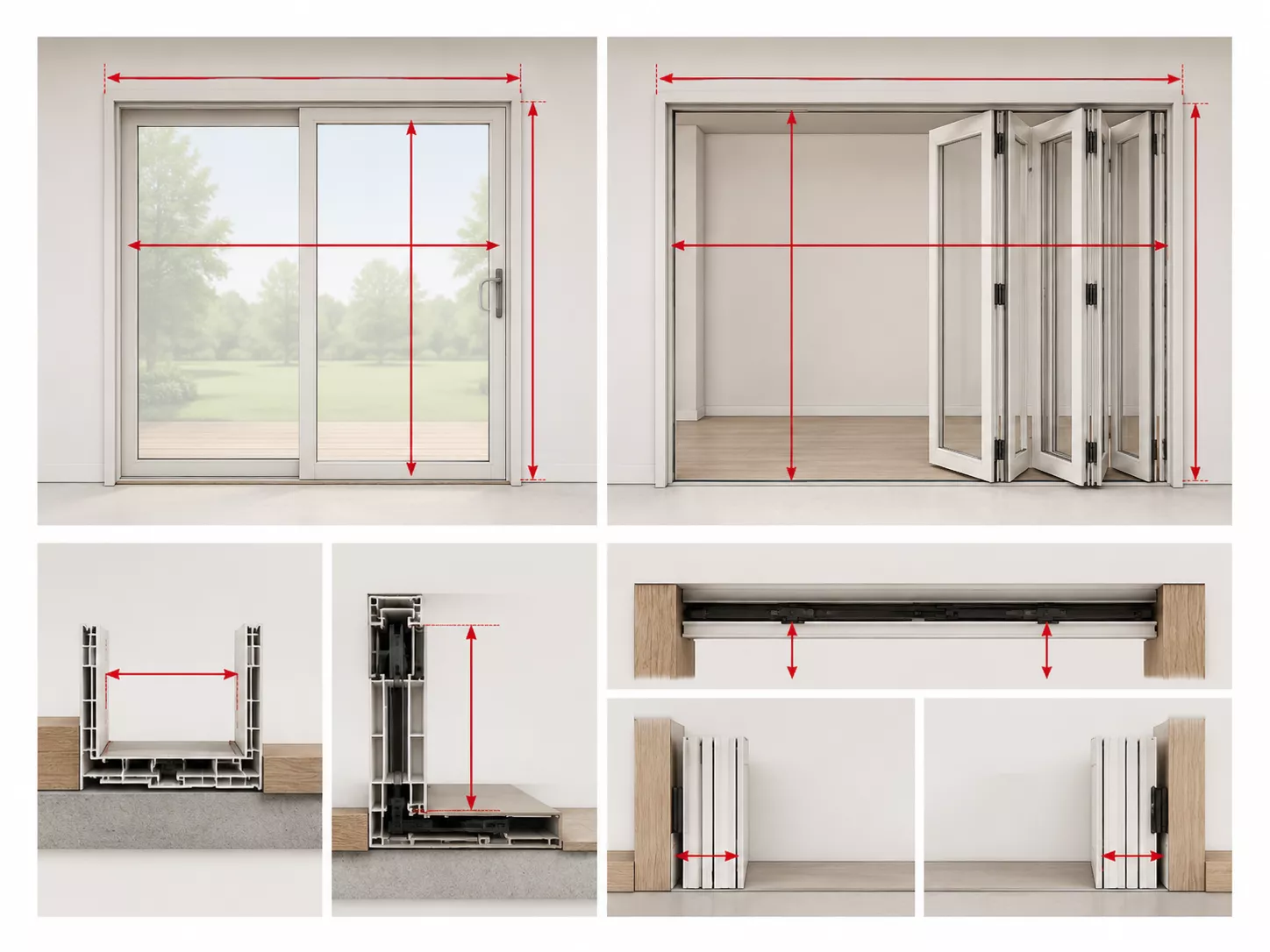
Accurate measurements are the foundation of any successful door installation. Order a door that’s even a quarter-inch off in the wrong direction, and you’re looking at gaps, drafts, or a unit that simply won’t fit. This guide breaks down exactly how to measure for both vinyl sliding doors and bifold doors so you order the right size the first time.
Tools You’ll Need
- Steel tape measure (avoid cloth or fabric tapes, which stretch)
- Notepad or measurement worksheet
- A helper for larger openings
- Ladder for taller openings
General Measuring Rules
Always measure in three places for each dimension—width and height—and use the smallest measurement. Older homes especially can have openings that sit slightly out of square, so never assume one measurement applies across the whole frame. Measure to the nearest 1/8 inch, and always double-check before ordering, since custom vinyl doors are typically non-returnable. If you are upgrading to high-quality doors and windows for indoor-outdoor living , getting these foundational numbers right ensures a flawless installation.
Measuring for a Vinyl Sliding Door
When you prepare to order sliding patio doors for open views, precision is critical. Follow these specific steps:
Step 1: Measure the Width
Measure the rough opening width at the top, middle, and bottom of the frame, from stud to stud (or from existing jamb to jamb if replacing an existing door). Use the smallest of the three measurements as your working width.
Step 2: Measure the Height
Measure the height at the left side, center, and right side, from the subfloor or threshold to the header. Again, use the smallest measurement.
Step 3: Check for Square
Measure both diagonals of the opening, corner to corner. If the two diagonal measurements differ by more than 1/4 inch, the opening is out of square, and you may need to account for this during installation or consult a professional before ordering.
Step 4: Measure Depth
Measure the depth of the opening from interior to exterior finished surface, especially important for exterior walls, to ensure the door frame will fit within the wall thickness.
Step 5: Note the Rough Opening vs. Unit Size
Manufacturers typically require a rough opening that is 1/2 inch to 1 inch larger than the actual door unit in both width and height, to allow for shimming. Check your specific manufacturer’s spec sheet, as this varies by brand and product line.
Step 6: Account for Sill Condition
If you’re replacing an existing sliding door, inspect the subfloor and sill for water damage or rot before finalizing measurements. A damaged sill may need to be rebuilt, which can change your final rough opening dimensions.
Measuring for Vinyl Bifold Doors
Before you shop custom and standard-size bifold doors, use this process to capture the correct dimensions:
Step 1: Measure the Opening Width
Measure the width of the finished opening (not the rough framing) at the top, middle, and bottom. Bifold doors are sized to the finished jamb opening, not the rough construction opening, since they typically mount inside an existing frame or closet opening.
Step 2: Measure the Opening Height
Measure from the floor to the top of the jamb or header at three points across the width of the opening. Note any flooring that will be installed after the door, such as carpet or tile, and adjust your height measurement to account for the finished floor level.
Step 3: Measure Jamb Depth
Measure the depth of the door jamb from the front face to the back face. This tells you whether standard track hardware will fit or if you need an extended track system.
Step 4: Determine Panel Configuration
Bifold doors come in various configurations, such as two-panel, four-panel, or six-panel sets, and can be single (folding to one side) or double (folding to both sides). Measure the full opening width, then decide on configuration based on how much clearance you have on each side for the folded panels.
Step 5: Check for Obstructions
Look for any door casing, baseboards, or electrical outlets near the opening that could interfere with the folded door panels or track installation, and note their position relative to your measurements.
Sliding Door vs. Bifold Door: Measurement Differences at a Glance
| Measurement | Sliding Door | Bifold Door |
|---|---|---|
| Reference point | Rough framing opening | Finished jamb opening |
| Depth measurement | Wall thickness | Jamb depth only |
| Square check | Diagonal comparison | Diagonal comparison |
| Clearance allowance | 1/2″ to 1″ for rough opening | Minimal, fits inside existing jamb |
| Floor consideration | Threshold and sill height | Finished floor height |
Common Measuring Mistakes
- Measuring only once instead of at three points
- Forgetting to check for square using diagonal measurements
- Confusing rough opening size with actual door unit size
- Not accounting for finished flooring that will be added later
- Failing to measure jamb depth for bifold installations
Final Thoughts
Careful, repeated measurements are cheap insurance against an expensive mistake. When in doubt, measure twice, use the smallest figure among your readings, and confirm your numbers against the manufacturer’s specific rough opening requirements before placing an order. If your opening is significantly out of square or shows signs of structural damage, it’s worth having a contractor assess it before you measure for Vinyl Sliding & Bifold Doors.