
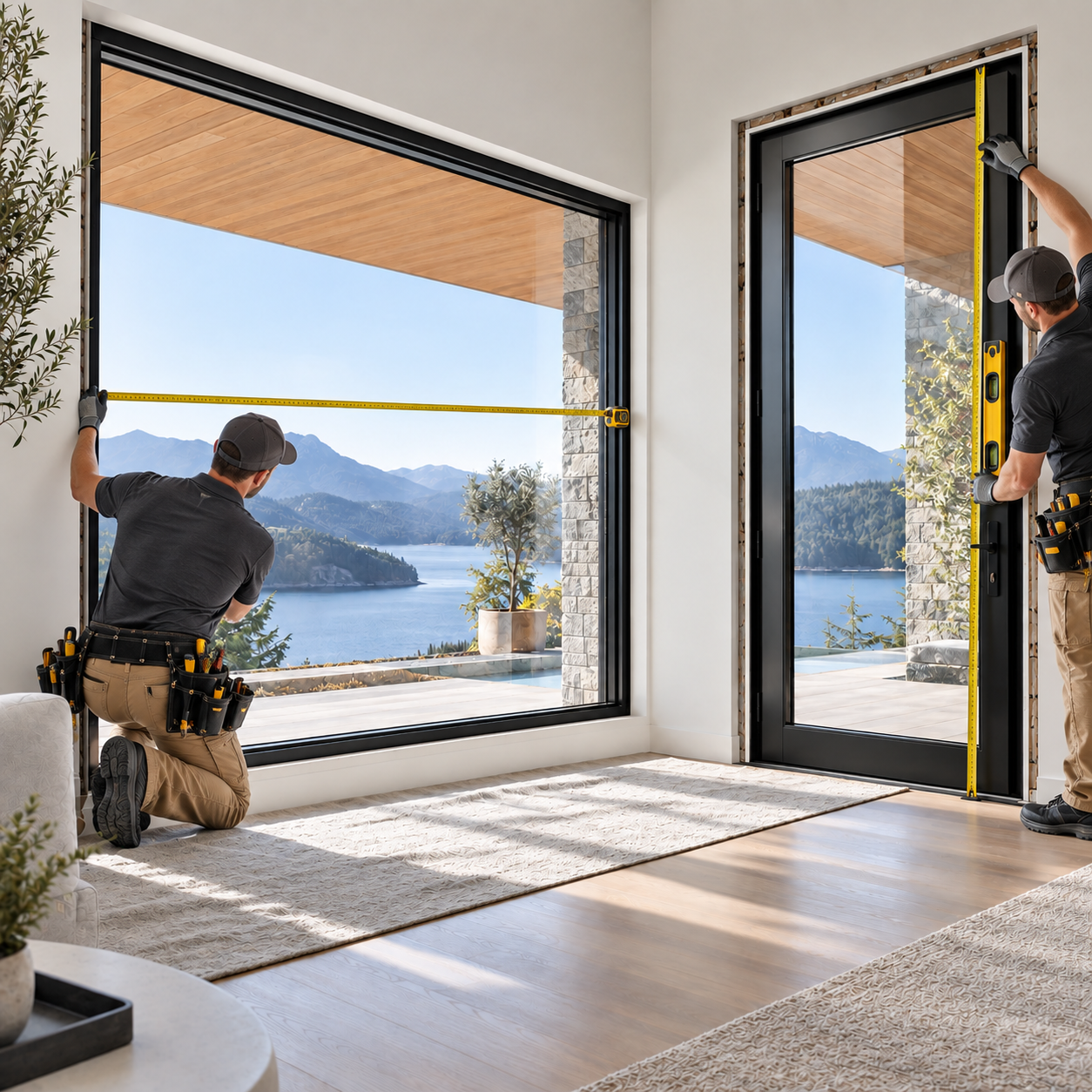
Picture doors and windows are fixed glass — they do not open — so the only things that matter are an accurate width, height and squareness, plus where the unit will sit. Because picture units are often large, a small measuring error is costly; we strongly recommend A1’s free professional measurement for openings over 6 ft wide.
What you need
- Steel tape measure (25 ft or longer)
- Level (4–6 ft) and a pencil
- Notepad or phone
- A helper — essential for wide or floor-to-ceiling openings
Step 1: Identify the opening type
- Replacement (existing frame stays): measure inside the existing frame, jamb to jamb.
- New construction or full-frame replacement: measure the rough opening, stud to stud and header to sill.
- Picture door / fixed glass panel: a full-height fixed panel, often next to a sliding, bifold or entry door. Measure from the finished floor (or sill) to the header.
Step 2: Measure the width
- Measure across the top, middle and bottom.
- Record each to the nearest 1/8 inch.
- Use the smallest measurement.
Step 3: Measure the height
- Measure left side, center and right side.
- Record each to the nearest 1/8 inch.
- Use the smallest measurement.
For floor-level picture doors, also check the floor is level across the opening. Note any slope over 1/4 inch.
Step 4: Check squareness
Measure both diagonals. A difference of more than 1/4 inch means the opening is out of square. With large fixed glass this matters more than with opening windows, because the glass cannot flex — note it on your order.
Step 5: Deduct for fit
Frames are usually ordered about 1/2 inch smaller than the rough opening in width and height to allow for shimming and sealant. Send us your exact numbers and we will confirm the final size before production.
Step 6: Note glass and safety requirements
Tell us if the picture unit is:
- Part of a door, or next to a door
- Within 18 inches of the floor
- Near a bathtub, shower, pool or stairs
These locations typically require tempered safety glass under building code. Also tell us your preferences for Low-E, tint or obscure glass.
Step 7: Check access for delivery
Large picture units arrive as one piece. Measure doorways, hallways, stairs and gates along the route to the opening so the unit can get there.
Common mistakes to avoid
- Using the largest measurement instead of the smallest
- Forgetting the floor slope on full-height picture doors
- Not checking whether the unit fits through the house to the opening
- Not mentioning nearby doors or wet areas that need safety glass