
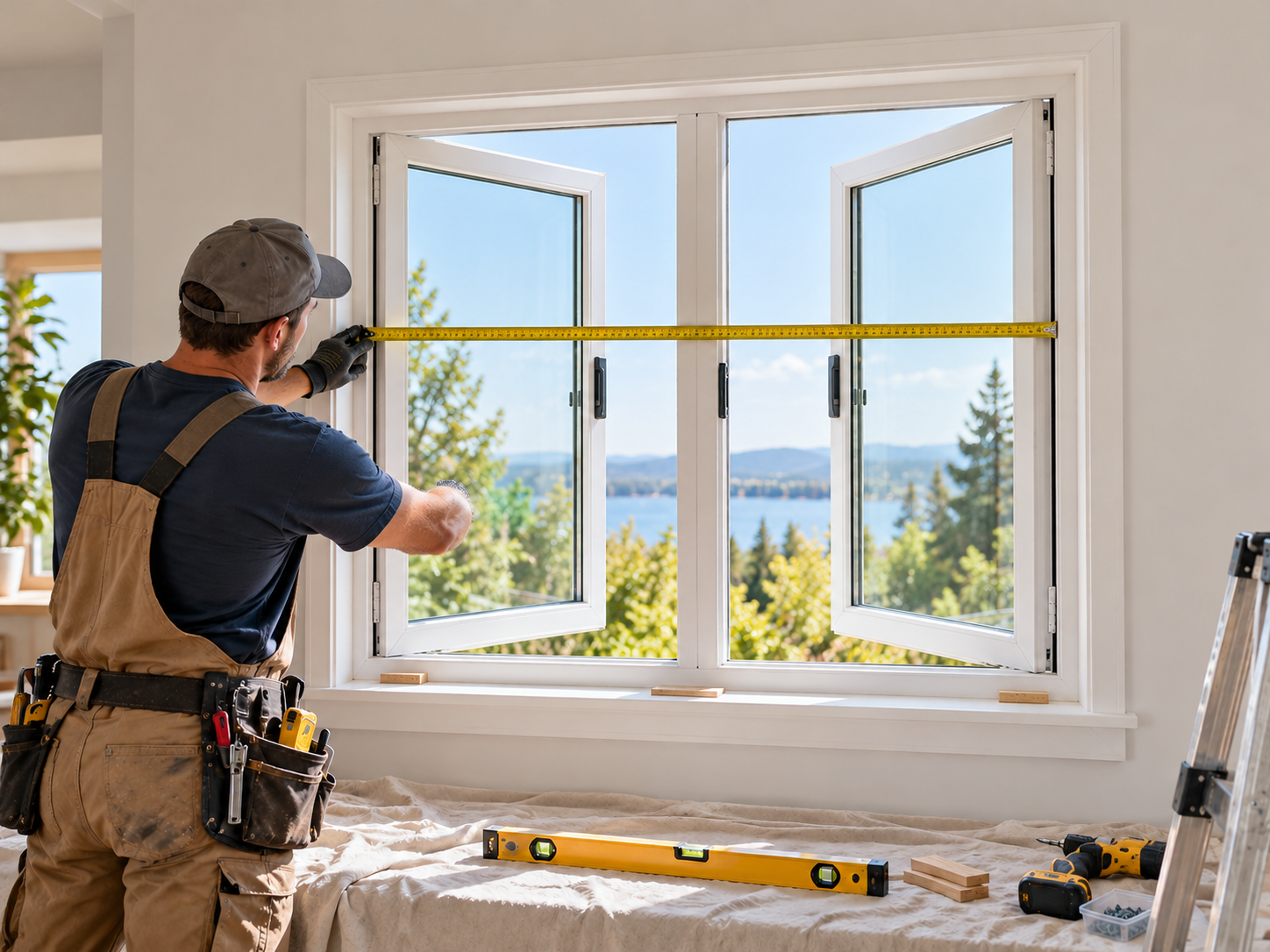
Measure the opening in three places each way, use the smallest number, and tell us which side the hinges go on. That is all it takes to order a casement that fits.
What you need
- Steel tape measure (25 ft)
- Level and a pencil
- Notepad or phone to record numbers
- A helper for wide or tall openings
Step 1: Decide what kind of opening you have
- Replacement (existing frame stays): measure inside the existing frame, jamb to jamb.
- New construction or full-frame replacement (old frame removed): measure the rough opening — the framed wall opening, stud to stud and header to sill.
If you are not sure which applies, take photos of the inside and outside of the opening and send them to us.
Step 2: Measure the width
- Measure across the top, middle and bottom of the opening.
- Record all three numbers to the nearest 1/8 inch.
- Use the smallest of the three.
Step 3: Measure the height
- Measure top to bottom on the left side, the center and the right side.
- Record all three numbers to the nearest 1/8 inch.
- Use the smallest of the three.
Step 4: Check that the opening is square
Measure both diagonals, corner to corner. If they differ by more than 1/4 inch, the opening is out of square. Note it on your order — we may recommend a slightly smaller unit or shimming during installation.
Step 5: Deduct for fit
For a rough opening, the window or door frame is usually ordered about 1/2 inch smaller than the opening in both width and height. This leaves room to level, shim and seal. Give us your exact measurements and we will confirm the final frame size before production.
Step 6: Choose the swing direction (handing)
Casements are hinged on one side and swing open like a door.
- Windows: standing outside looking at the window, tell us whether the hinges are on the left or the right. Most casement windows open outward.
- Doors: tell us whether the door swings in or out, and which side the hinges are on when viewed from outside.
- Pairs (French-style): tell us which panel opens first (the active panel).
Step 7: Check the swing clearance
Make sure nothing blocks the sash or door as it opens: railings, plants, light fixtures, furniture, rugs or a sloped patio. A door also needs a level floor or threshold across its full width.
Common mistakes to avoid
- Measuring the old window sash instead of the opening
- Using the largest measurement instead of the smallest
- Forgetting to note the hinge side and swing direction
- Measuring in metric and imperial on the same order