
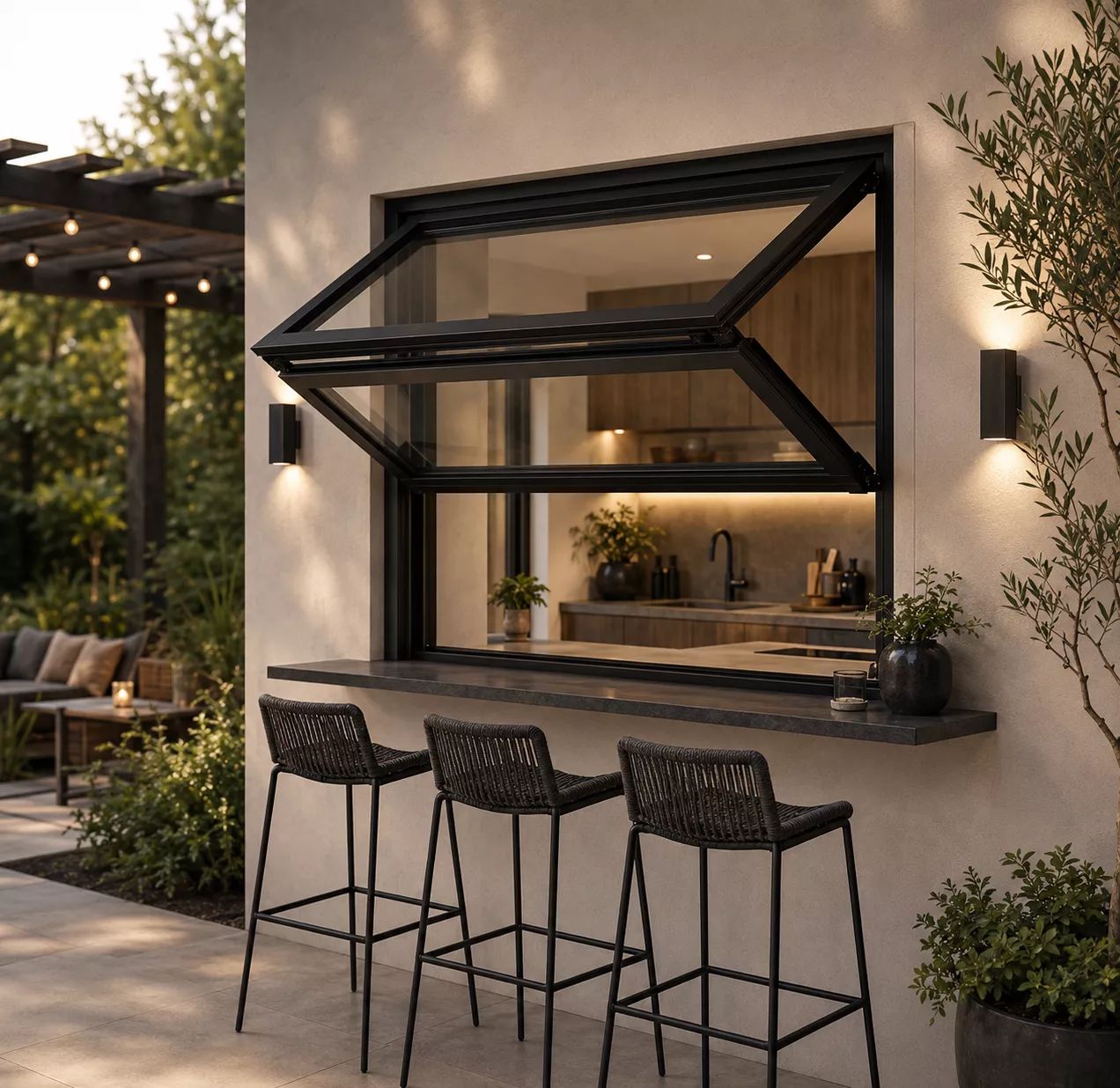
Folding-up windows, also known as top-hung awning windows, use hinges along the top edge and swing outward and upward. Arms, props, or gas struts hold them open. Homeowners and businesses often install them above server counters, outdoor kitchens, and café hatches because they create a wide, unobstructed opening. Because the sash pivots on a top hinge rather than sliding or folding sideways, accurate measurements are critical to ensure the hinge line sits correctly, the sash swings freely, and the seal compresses evenly when closed.
Why Accurate Measurements Matter
A folding-up window relies entirely on its top hinge and support arms for safe, smooth operation. Getting the opening size wrong can cause the sash to bind against the frame, prevent the arms from locking in the open position, or leave gaps that let in water and draughts. Correct measurements ensure smooth pivoting action, a weathertight seal, safe overhead clearance, and a frame that installs without packing or trimming.
Tools You’ll Need
Steel tape measure, spirit level, pencil, notepad or phone, step ladder, and a second person to help hold the tape for wider openings. Always measure in one consistent unit throughout.
Measure the Width
Measure the structural opening width at three points — top, middle, and bottom. If the measurements vary, use the smallest figure so the frame isn’t forced into a tapering opening.
Measure the Height
Measure height at the left, center, and right of the opening, from the sill or counter surface to the underside of the head (where the top hinge will sit). Use the smallest measurement recorded.
Measure the Structural Opening, Not the Old Frame
When replacing an existing folding up window, measure the raw opening after removing trims, not the old frame itself, since old frames can mask uneven or shifted openings.
Check the Opening Is Square
Measure diagonally corner to corner in both directions. The two figures should match closely; a noticeable difference means the opening needs correcting before the hinge line and sash can sit true.
Check the Head Is Level
Because the hinge runs along the top of the frame, the head must be perfectly level — even a slight lean will cause the sash to swing unevenly or drift shut. Check with a spirit level along the full width of the head.
Allow Clearance for the Swing Arc
Unlike a sliding window, a folding up sash swings outward and rises above the opening when fully raised. Measure the vertical clearance above the opening. Check for eaves, gutters, pergola beams, ceiling fans, and hanging light fittings. Also, confirm there is enough space below for people to pass safely under the raised sash.
Standard Sizes
Common folding up window sizes include 36 × 24 in, 48 × 36 in, 60 × 36 in, 72 × 36 in, and up to 120 × 36 in for wide server openings. Larger spans are typically split into multiple hinged panels or supplemented with additional struts.
Measuring for Custom Units
For custom folding up windows, also confirm frame depth, wall construction, finished counter height, strut or arm type (gas strut vs. friction stay), glazing choice, handle and lock position, and the desired maximum open angle.
Measurement Checklist
✔ Width measured in three places
✔ Height measured in three places
✔ Opening checked for square
✔ Head checked for level
✔ Structural opening measured, not old frame
✔ Overhead swing clearance confirmed
✔ Standard or custom sizing confirmed
<h2 class=”font-claude-response-body break-words whitespace-normal”>When to Request a Professional Site Measure
Professional measurement is strongly recommended for large spans, multi-panel configurations, and commercial server applications. It is also advisable for openings with visible irregularities. This is because hinge alignment tolerances are tighter than those for sliding or fixed windows.
FAQs
Can I measure a folding up window myself?
Yes, for a preliminary check, but professional verification is advised before ordering, especially for wide spans.
Do I need extra overhead clearance?
Yes — the sash rises above the opening line when fully open, so overhead obstructions must be accounted for.
What if the head isn’t level?
Correct it first; an unlevel head is the most common cause of a folding up sash swinging shut on its own.