
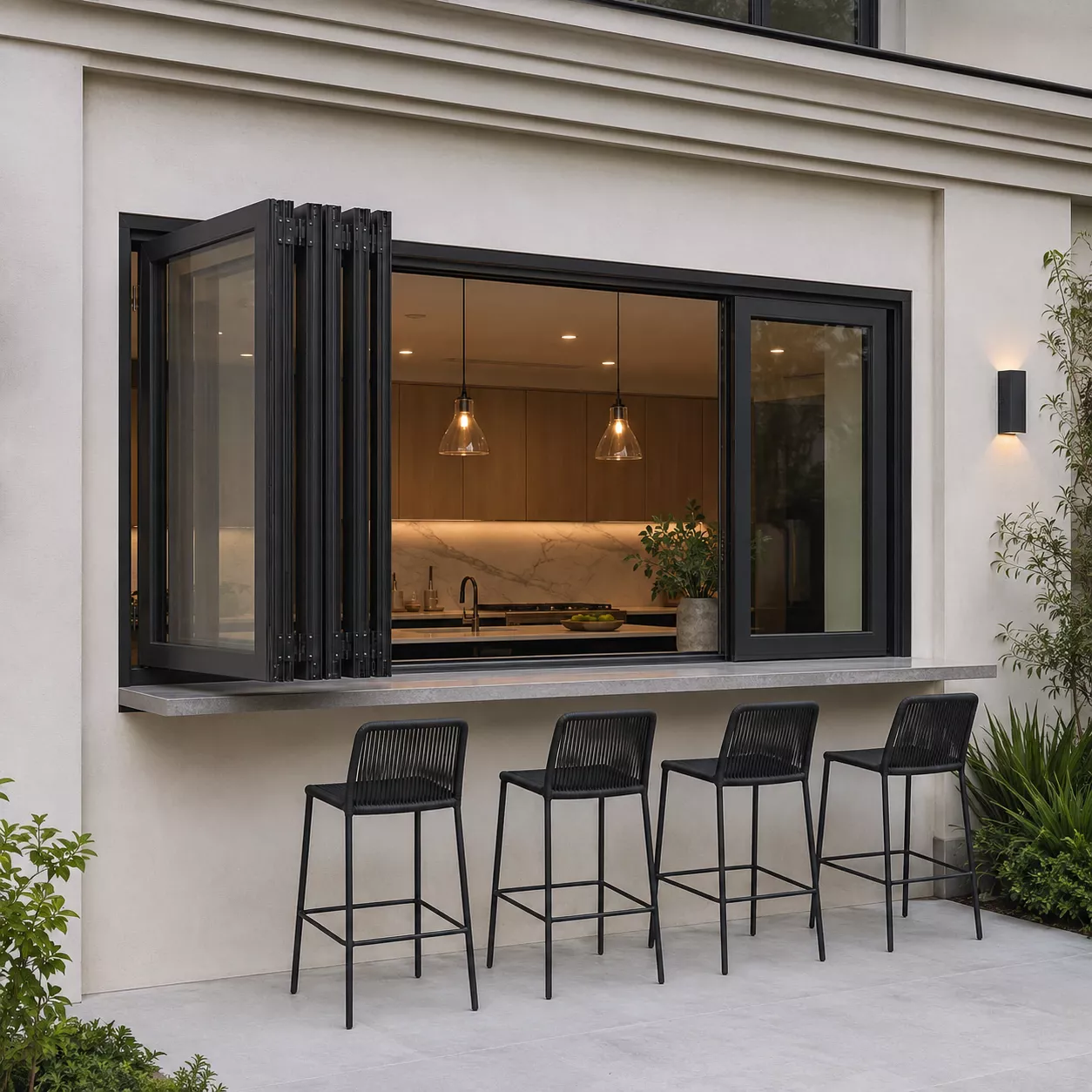
Bifold windows rely on precisely aligned top and bottom tracks and correctly hung, hinged panels to fold and stack smoothly. Getting the track level and the panels sequenced correctly is the foundation of a successful installation.
Before You Begin
Check the frame, all panels, hinges, rollers, top and bottom track, handles, locks, glass, and fixings on arrival. Confirm panel numbering matches the installation sequence supplied by the manufacturer.
Tools You’ll Need
Tape measure, spirit level (including a long level for the track run), drill and bits, impact driver, screwdrivers, silicone sealant and gun, rubber mallet, packers/shims, utility knife, safety gloves and glasses, and a ladder.
Prepare the Opening
Confirm that the opening matches the manufactured frame, is square, and that both head and sill lines are level. Clear debris and old sealant from the opening.
Position and Secure the Frame
Lift the frame into the opening, center it with even clearance, and support with packers. Check level and plumb along the head, jambs, and sill before fixing, rechecking after each fixing point to ensure the frame hasn’t twisted.
Install the Track
Fix the top track first, checking it is perfectly level and straight along its full length, then fit the bottom track or guide directly below it, confirming both are parallel. Any misalignment between the two tracks will cause the panels to bind.
Hang the Panels in Sequence
Starting from the fixed or hinge-anchor end specified by the manufacturer, hang each panel in order, connecting the hinges between panels as you go. Check each panel hangs plumb and rolls freely on the track before moving to the next.
Adjust Rollers and Hinges
Fine-tune the top rollers so each panel hangs evenly and the stack folds without dragging on the track or sill. Check hinge alignment between panels so the fold is smooth and consistent.
Check Alignment
Fold and unfold the full panel set several times, confirming smooth movement, even stacking, correct closing alignment, and that the locking panel seats squarely into the frame.
Install Handles and Locking Hardware
Fit handles and multi-point locks as specified, checking smooth engagement across the full closed panel run.
Apply Weather Seals and Sealant
Seal the perimeter frame with exterior-grade silicone, and check the compression seals between each panel are seated correctly. Keep track drainage points clear.
Final Checks
✔ Frame level
✔ Top and bottom tracks level and parallel
✔ Panels fold and stack smoothly
✔ Locks engage
✔ Handles operate
✔ Seals fit properly between panels and frame
✔ Drainage clear
✔ Glass undamaged
Common Mistakes to Avoid
Fixing the top track before checking its level, hanging panels out of sequence, misaligning top and bottom tracks, and over-tightening hinge screws.
FAQs
Can I install a bifold window myself?
Two- or three-panel residential units may suit experienced DIYers, but wider commercial configurations should be professionally installed.
Why won’t my panels close flush?
Usually, a roller or hinge adjustment issue, or a track that isn’t level — check before assuming a manufacturing fault.
Do bifold windows need a bottom track?
Most systems use one for stability, though some top-hung designs rely on the head track alone with a floor guide.